Q1 2024 Commentary and Outlook
Throughout the first quarter of 2024, Canadian real estate navigated interest rate uncertainty, a slower economy, and stabilizing inflation as anticipation built for a potential rebound in the market.
That said, early 2024 still presents rich possibilities for investors in the Canadian multi-family space. Growing rental prices and occupancy rates maintain near-record highs, supported by ever-rising immigration and low supply. An undervalued environment provides a buyer’s market, creating an opportunity to bolster portfolios with new acquisitions presenting long-term growth potential.
Against this backdrop, the Equiton Residential Income Fund Trust (the Trust) ended the quarter with a net return of 2.12% (Class F DRIP).
A rate cut is likely to renew confidence among prospective homeowners navigating increased living expenses and challenging mortgage rates. Regardless, for most it may not be enough to support the transition from renting to ownership. The Canada Mortgage and Housing Corporation (CMHC) projects the national average home price could reach 2022’s historic $816,7207 by 2025 and surpass it the following year. In the agency’s view, homeownership barriers will drive record rental occupancy and rent increases on unit turnover in 2024.
In Vancouver, the expenses of owning a representative two-bedroom condo exceeded renting by 66.3%. Meanwhile, in relatively affordable condo markets, such as Ottawa and Edmonton, the difference worked out to 10.5% and 9.2%, respectively.
Mitigating Construction Headwinds Through Self-Performing Capabilities
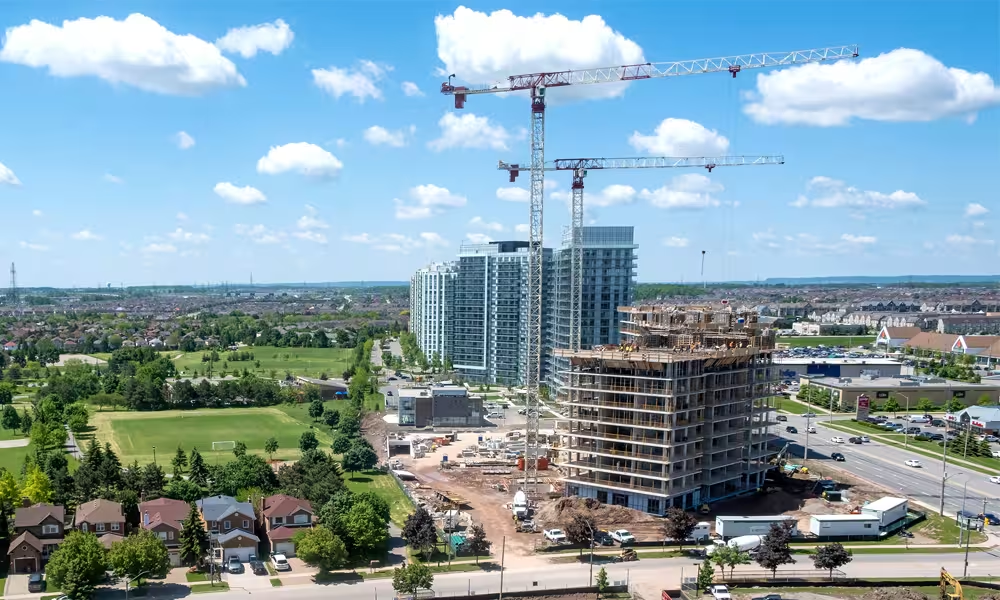
As governments weigh courses of action, Equiton has taken a proactive stance to mitigating prevailing uncertainties. The firm’s development arm, Equiton Developments, is in the process of building its self-performing construction capabilities. Bringing construction in-house will enable Equiton to manage its own timelines and create operational efficiencies in all economic environments.
In partnership with Ottawa developer Main and Main, Equiton is expected to bring the first tower of its 1,100-unit Maison Riverain project online in early 2025. Future phases will benefit from federal and provincial tax cuts on purpose-built rentals.
Non-Permanent Resident Caps Anticipated to Have Low Immediate Impact
The impact of these immigration caps may be short-lived due to the rate at which demand is growing. For example, reduced student admissions could moderate rental growth in the near term, but are unlikely to reduce overall demand.
Generally, the government’s housing plan pledged several measures to make home ownership more attainable in addition to increasing housing supply. To that end, the government expanded its low-cost rental construction loan program by an additional $15 billion. Also, it committed $6 billion to infrastructure and plans to open underutilized public lands for development. The plan’s ambitious target is to encourage the creation of 3.87 million homes by 2031, with a focus on rentals.
Demand-side measures gave first-time homebuyers access to 30-year mortgages when buying new builds and an increased $60,000 withdrawal limit for the RRSP Homebuyers Plan. The government also barred corporations from purchasing single-family homes. The targeted nature of these measures is unlikely to stoke undue demand among prospective owners. On the other hand, overall construction productivity may receive a much-needed boost.
Capital gains tax increase may impact some, but not all, real estate investors
Beyond housing and affordability measures, the federal budget increased the capital gains tax inclusion rate effective June 25. Individuals will pay taxes on 66.7% of realized capital gains exceeding $250,000, while companies will pay the higher inclusion rate on all investment profit.
As such, institutional real estate corporations will likely execute the majority of transactions this year. With access to large pools of free capital, they are strongly positioned to buy and sell assets strategically.
Building vibrant communities and fostering resident satisfaction remain key to growing a resilient business. Satisfied residents have longer tenures and contribute to higher occupancy rates, providing a source of stable, long-term rental returns.
This improvement reflects the effectiveness of Equiton’s active approach to property management. Its subsidiary, Equiton Living, stations trained Resident Managers at every property to maintain open communication and respond to resident needs. Three Equiton properties won the 2023 SatisFacts Resident Satisfaction Award, which recognizes superior resident satisfaction and retention rates, in Q1’24.
Equiton has continued to make progress on its waste audit program. The program monitors waste outflow with the aim of reducing costs. Next quarter, Equiton expects to complete waste audits across all properties and continue lighting, water, and boiler-room upgrades.
A Turning Point for Canadian Real Estate?
Informations prospectives
Forward-looking information may relate to future events or the Trust’s performance.
Forward-looking information includes, but is not limited to, information regarding the Trust’s distributions, growth potential and volatility, investor returns, ability to achieve operational efficiencies, objectives, strategies to achieve those objectives, beliefs, plans, estimates, projections and intentions; and similar statements concerning anticipated future events, results, circumstances, performance or expectations and other statements that are not historical facts. These statements are based upon assumptions that the management of the Trust believes are reasonable, but there can be no assurance that actual results will be consistent with these forward-looking statements.
Forward-looking information involves numerous assumptions, known and unknown risks, and uncertainties that contribute to the possibility that the forward-looking statements will not occur and may cause actual results to differ materially from those anticipated in such forward-looking statements. Some of these risks are discussed in the section “Risk Factors” in the Offering Memorandum. These forward-looking statements are made as of the date of this communication and the Trust is not under any duty to update any of the forward-looking statements after the date of this communication other than as otherwise required by applicable legislation.













































Q1 2024 Commentary and Outlook – A Turning Point for Rentals?